Last Updated: March 2026
You can decorate a beautiful home on any budget — and I mean any budget. The secret isn’t hunting for the cheapest possible items. It’s about knowing exactly where to spend, where to save, and which tricks actually work versus which ones just look good on Pinterest. I’ve decorated a 480 sq ft studio on $650 total, thrifted an entire living room for $340 that would’ve cost $2,100 at retail, and made enough mistakes along the way to save you from repeating them. This guide covers everything: mindset, room-by-room budgets, shopping strategies, DIY projects, and the common errors that make budget spaces look cheap instead of chic.
Table of Contents
- What Is Budget Home Decorating (and What It’s Not)
- The Budget Decorating Mindset
- Room-by-Room Budget Breakdowns
- The Best Places to Shop on a Budget
- DIY Projects That Actually Elevate Your Space
- Color: The Free Decorator’s Best Friend
- Thrift Store Strategies
- Small Space Decorating
- Seasonal Refreshes Without Starting Over
- Common Budget Decorating Mistakes to Avoid
- Frequently Asked Questions
What Is Budget Home Decorating (and What It’s Not)
Budget decorating doesn’t mean cheap decorating. There’s a huge difference between the two, and I wish someone had explained it to me before I wasted $200 on a rug that fell apart in three months.
Budget decorating is about intentional spending — choosing where to invest a little more (a quality sofa, a real wood coffee table) and where to spend almost nothing (throw pillows, candles, seasonal accents). It’s about patience, creativity, and knowing that a $15 thrift find properly staged can look like a $150 boutique piece.
What it’s NOT: buying the absolute cheapest version of everything, hoarding clearance items you don’t love, or recreating a Pinterest board you found last Tuesday. Cheap decorating leaves you with rooms that feel incomplete, cluttered, or like a yard sale. Budget decorating leaves you with rooms that feel curated.
According to interior designer Emily Henderson — whose blog documents real-budget renovations — the number one rule of budget decorating is “buy less, buy better.” Five thoughtfully chosen pieces will always beat fifteen random ones, no matter the price tags.
The Budget Decorating Mindset
Before you buy a single thing, there’s mental work to do. This is the step most people skip, and it’s why so many “budget makeovers” end up feeling scattered.
Define Your Style First
You don’t need a design degree to have a style. Go through your phone’s saved photos. What rooms do you keep screenshotting? Is it cozy and warm with lots of wood and woven textures? Clean lines with pops of color? Moody and layered? That pattern is your style — and naming it will keep you from buying a boho rattan chair for a room that wants to be minimalist Japandi.
Set a Real Budget Per Room
Here’s a framework that works. Assign 60% of your room budget to the one or two “anchor” pieces (sofa, bed frame, dining table). Use 25% for secondary pieces (side tables, rugs, lighting). Keep the remaining 15% for decor accents — art, plants, throw pillows, candles.
For a living room with a $400 budget: $240 toward a sofa (check Facebook Marketplace), $100 toward a rug and lamp, $60 toward everything else. It sounds tight, but it’s very doable if you’re patient and strategic.
Shop in This Order
- What you already own (rearrange, repurpose, remove what doesn’t fit)
- Thrift stores and Facebook Marketplace
- Dollar Tree and discount bins for accents
- IKEA for functional basics
- Target and Walmart clearance sections
- Full retail — only as a last resort
The order matters. Most people start at step 6 and work backward. Flip it, and you’ll stretch every dollar.
Room-by-Room Budget Breakdowns
According to Furnishr’s 2026 cost report, furnishing an entire home from scratch averages $15–$25 per square foot. For a 1,500 sq ft home, that’s $22,500–$37,500. That’s the starting point we’re working way below.
Living Room: $150–$500
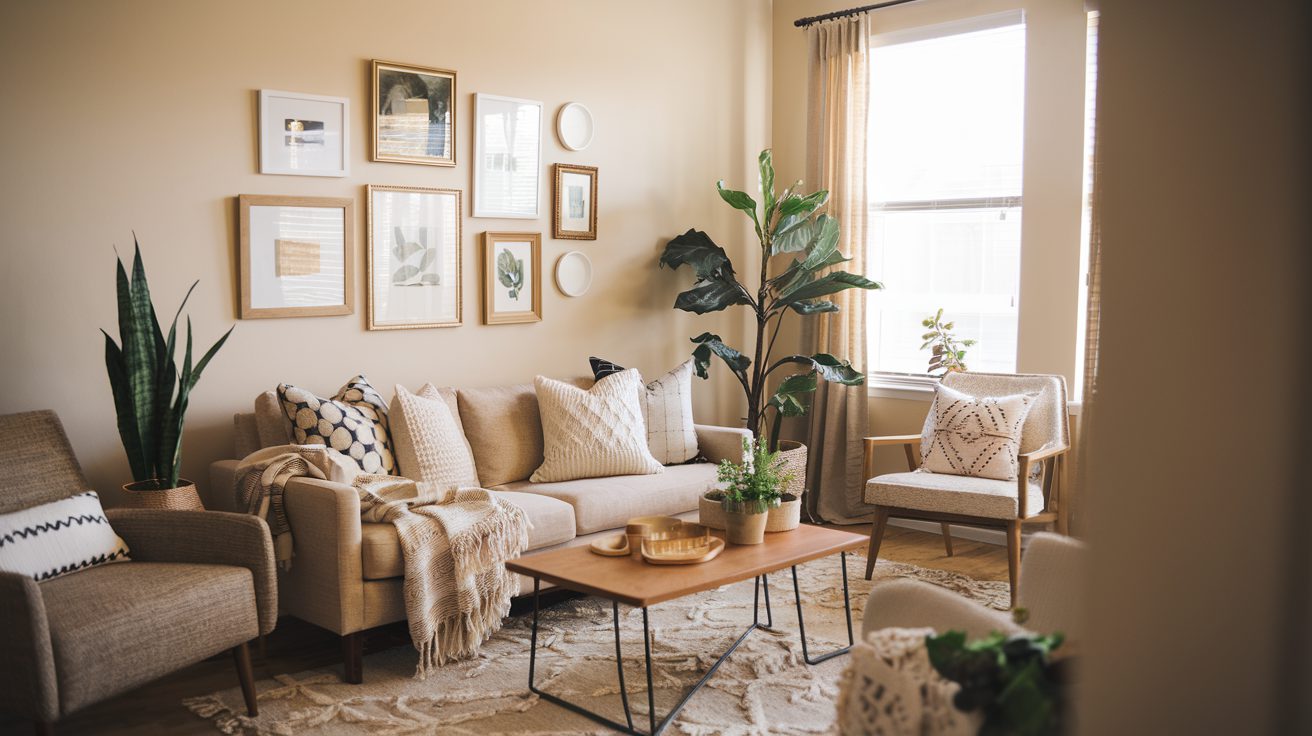
The living room is where most people overspend. A $1,200 sofa from a furniture store is almost never necessary. Facebook Marketplace and thrift stores regularly have solid sofas in great condition for $80–$200. Add a $25 throw blanket and $15 worth of pillows and it looks completely different.
| Item | Budget Option | Where to Find |
|---|---|---|
| Sofa | $80–$200 | Facebook Marketplace, thrift |
| Coffee table | $0–$50 | Thrift, IKEA LACK ($24.99) |
| Rug | $30–$80 | Walmart, IKEA, HomeGoods |
| Floor lamp | $20–$45 | Target clearance, thrift |
| Throw + pillows | $15–$40 | Dollar Tree, IKEA, TJ Maxx |
| Wall art / gallery | $0–$25 | Free printables, thrift frames |
Want the full breakdown? See our budget room makeover guide under $200 for exact item lists and sourcing tips.
Bedroom: $100–$350
The bedroom is actually the easiest room to do on a tight budget — because 90% of the impact comes from textiles and lighting, which cost almost nothing. A set of quality white sheets ($22 at Walmart), a $30 duvet cover from IKEA, and two matching lamps from a thrift store can completely transform how a bedroom feels.
Invest here: a good bed frame if you don’t have one ($79–$150 on Amazon or IKEA). Skip: a matching nightstand set — a stacked crate ($0) or a painted thrift find looks more interesting anyway.
Kitchen: $50–$200
You can’t always renovate a rental kitchen, but you can transform how it looks and feels. New cabinet hardware makes a startling difference — a full set of handles runs $18–$35 at Walmart or Amazon. A peel-and-stick backsplash tile (I’ve tested 23 versions — the Smart Tiles brand is one of the few that actually stays put) costs about $25–$40 for a standard area.
Add a $12 plant on the counter, a matching canister set from Dollar Tree, and a new dish towel set, and suddenly your kitchen feels intentional. Total spend: under $70.
Bathroom: $30–$100
Bathrooms punch above their weight when it comes to budget upgrades. A coordinated set of accessories — soap dispenser, toothbrush holder, small tray — instantly elevates the vibe. Dollar Tree sells these for $1.25 each. Add a new shower curtain ($15–$25 at Target or HomeGoods), a fluffy bath mat ($8–$15), and a plant (pothos thrive in humidity), and your bathroom looks like a spa.
The Best Places to Shop on a Budget in 2026
Not all budget stores are created equal. Here’s the honest breakdown of where to find what — based on years of personal shopping at all of them.
Dollar Tree ($1.25/item)
Best for: candles, fake plants, frames, small storage containers, bathroom accessories, seasonal decor, vases, ribbon and crafting supplies. Skip: anything structural or meant to hold weight. The shelves are a gamble.
IKEA
Best for: storage systems (KALLAX, RASKOG, SKUBB), basic furniture frames, rugs, lamps, and organizational inserts. The KALLAX cube shelf system starts at $49.99 and is endlessly hackable — I spent $8 in contact paper to make mine look completely custom, and it’s still holding up two years later.
Speaking of which — our guide to the best IKEA hacks, ranked by effort and impact, shows you exactly which transformations are worth it.
Facebook Marketplace & Thrift Stores
This is where the real magic happens. I’ve found solid wood coffee tables for $15, barely-used sofas for $100, and vintage mirrors for $8 that I cleaned up and sold for $85. The key is showing up consistently (not once), knowing your measurements before you go, and being willing to look past current condition — because paint, hardware, and a good cleaning change everything.
For a deep dive, read our complete thrift store living room makeover — I document every single item I found and how much I paid.
Target & Walmart
Both stores have dramatically improved their home sections. Target’s Studio McGee collaboration brings genuinely good-looking pieces at accessible prices — the trick is watching the clearance section, where prices drop 30–70% within 6–8 weeks of a new collection launching.
Walmart’s Better Homes & Gardens line is consistently underrated. Their storage ottomans ($35–$60), curtain panels ($14–$22), and accent chairs ($89–$120) look far more expensive than they are.
Amazon
Good for: reading the reviews before committing to anything. Amazon home decor is a mixed bag — some incredible finds, some truly terrible ones. Filter reviews by photos, sort by “most critical,” and look for reviews that mention durability six months in. Never just look at the star rating.
DIY Projects That Actually Elevate Your Space
I want to be upfront here: not all DIY projects are worth your time. Some require tools you don’t own, skills you’d need to develop, and a weekend of frustration that leaves you worse off than when you started. Here are the ones that deliver high impact for low effort.
Gallery Wall ($0–$30)
A gallery wall instantly makes a space look more finished and personal. The budget version: print free printables (tons of beautiful options on Pinterest and Etsy), buy mismatched frames from Dollar Tree or thrift stores, paint them all the same color (one can of spray paint is $5), and arrange them on the floor first before committing to the wall.
Chalk-Paint Furniture Refresh ($15–$30)
Real talk: my first attempt at chalk-painted furniture was a disaster. I skipped the wax coat. The paint scratched within a week and looked terrible. Second attempt — properly waxed — is still going strong two years later. The lesson: follow the steps completely, especially the finishing coat. A quart of chalk paint runs $12–$18 at craft stores and can refresh an entire dresser.
Swap Hardware ($10–$35)
New cabinet and drawer pulls are the fastest way to make old furniture look intentional. Matte black pulls are having a major moment in 2026 and cost about $1.50–$3 per handle on Amazon. For a six-drawer dresser, that’s under $25 total for a completely different look.
Floating Shelves ($20–$40)
IKEA’s BERGSHULT floating shelf system is clean, minimal, and costs about $20–$30 per shelf bracket included. Add three shelves to a bare wall and you instantly have display space, storage, and visual interest. Style them with a mix of books, plants, candles, and one or two meaningful objects.
Color: The Free Decorator’s Best Friend
Paint is the most cost-effective transformation in home decorating — full stop. A gallon of interior paint costs $25–$45 and can completely change how a room feels, looks, and even how large it seems.
The 2026 color trends worth knowing for budget decorators: color drenching (painting walls, ceiling, and trim all the same color) is having a huge moment. According to The Spruce’s 2026 HomeGoods trend report, it creates an instant sense of depth and intention without requiring furniture upgrades. Warm terracotta, sage green, and soft blue-grey are the standout shades this year.
Accent Walls vs. Full Room
If you’re renting or nervous about committing to color: one accent wall behind a bed or sofa uses half a gallon (around $12–$20) and creates a dramatic focal point. If you’re ready to go all in, a full room in a bold-but-liveable color — dusty sage, warm cream, soft terracotta — will make your furniture look more expensive even if nothing changed.
For small rooms specifically, lighter values (not necessarily white — think pale blush, soft greige) visually expand the space. Our spring 2026 decor trends guide goes deeper on which colors are dominating right now.
Thrift Store Strategies That Actually Work
Thrifting isn’t luck. It’s a skill you develop, and once you have it, you’ll never pay full price for furniture again. Here’s what I’ve learned after eight months thrifting a complete living room.
Go Consistently, Not Occasionally
The best stuff gets picked up fast. Thrift stores rotate stock multiple times per week. If you only go once a month, you’re seeing leftovers. Going once a week for a quick 20-minute scan is far more effective than a three-hour deep dive monthly.
Know Your Measurements
Keep a note on your phone with the exact dimensions of your rooms and any gaps you’re trying to fill. Nothing worse than falling in love with a dresser that’s 4 inches too wide for your bedroom wall.
Look Past the Current Condition
Solid wood furniture with bad paint? Perfect candidate for chalk paint. Dated upholstery? Replace it with a $15 piece of fabric and a staple gun. Ugly lamp base? Spray paint it. The question to ask yourself is: is the structure sound? If yes, everything else is fixable.
For the full strategy including what to skip entirely (particleboard furniture, upholstery with mystery stains, anything that smells off), check out our thrift store living room makeover guide.
Budget Decorating in Small Spaces
Small spaces require a different set of rules. After decorating a 480 sq ft studio on a $650 budget, I can tell you: scale and visual flow matter more in small spaces than in large ones. One oversized rug does more than three small ones. One large mirror does more than five small pieces of art.
The Rules of Small-Space Decorating
- Go vertical: Use wall space aggressively. Tall bookshelves and stacked shelving draw the eye up and make ceilings feel higher.
- Choose multi-functional furniture: An ottoman with storage costs the same as a regular one but does twice the work. IKEA’s KALLAX doubles as a room divider and shelving unit.
- Mirrors: A large floor mirror or wall mirror placed opposite a window literally doubles the perceived light and space. Thrift one for $10–$30.
- Cohesive color palette: In a small space, visual clutter kills the vibe faster. Stick to 2-3 colors maximum. Contrast where it counts, repeat everywhere else.
The cheap rug mistake is especially brutal in small spaces. I bought a $30 rug for my studio that started shedding immediately and was warped within two months. The replacement — a $65 IKEA flatweave — is still perfect three years later. In small spaces, every item is on full display all the time. A little more on quality basics pays off.
If you’re working with a studio or compact apartment, I’ve put together a detailed studio apartment layout guide covering 10 configurations that actually work — from L-shape to Murphy bed setups. And for making any small room feel twice its size, these 15 designer tricks to make rooms look bigger are mostly free or under $50.
Seasonal Refreshes Without Starting Over
One of the smartest things you can do as a budget decorator is build a base layer that works year-round, then layer seasonal accents on top. Think of your sofa, rug, and main furniture as the permanent canvas. Think of throw pillows, candles, small vases, and textiles as the swappable elements.
A seasonal refresh doesn’t need to cost more than $20–$30. New candle scents ($3–$8 at Target or Walmart), a seasonal throw ($10–$15 at Dollar Tree), a few stems or a small potted plant, and some rearranging of what you already own — that’s genuinely all it takes to make a room feel like a different season.
The key: don’t buy seasonal decor at full price in season. Buy it at 50–75% off clearance after the season ends and store it. Your spring 2027 refresh can cost you $8 if you shopped smart in March 2026.
See how we approach this systematically in our spring 2026 home decor trends on a budget guide.
Common Budget Decorating Mistakes (and How to Avoid Them)
These are the ones that cost people the most money and the most frustration. I’ve made most of them personally.
1. Buying a Cheap Rug
I cannot stress this enough: a bad rug will ruin an otherwise good room. Cheap rugs shed, pill, slip, and look dated within months. A rug is structural — it anchors everything else. Spend more here, and go thrift or IKEA before buying a $30 synthetic one from Amazon. The IKEA ADUM and STOENSE lines are both under $100 for a 5×7 and genuinely hold up.
2. Buying Everything at Once
The urge to “finish” a room immediately leads to panic buying. Live in a space for a few weeks first. You’ll figure out what you actually need (versus what you thought you needed), where the natural traffic flow is, and which direction the light comes from — all of which affects what works aesthetically.
3. Too Many Small Pieces
A shelf full of twenty tiny figurines looks like clutter, not decor. Same with a wall of nine small prints. Budget decorators often compensate for cost with quantity — resist this. Three well-chosen pieces beat fifteen random ones every time. Edit down aggressively. When in doubt, take it off the shelf.
4. Ignoring Lighting
Overhead lighting from a single ceiling fixture is the enemy of a cozy room. It’s flat, harsh, and makes everything look like a waiting room. Add floor lamps and table lamps from thrift stores (a basic thrift lamp runs $5–$15) and put them on warm bulbs (2700K color temperature — always check the box). The difference is immediate and dramatic. This is the easiest, cheapest transformation you’re probably not doing.
5. Decorating Without a Plan
Walking through HomeGoods without a plan is how you spend $80 and come home with nothing that goes together. Know your color palette, your style direction, and what specific gaps you’re filling before you walk into any store. Your phone’s camera is your best tool — screenshot the room you’re shopping for so you can hold items up and see if they actually work.
Want to see how this looks in practice? Our guide to making your home look expensive on a budget walks through every design trick that makes the biggest visual impact for the least money.
For a deep dive into exactly which mistakes to avoid — with specific fixes and real prices — read our full guide to budget decorating mistakes that make your home look cheap.
Frequently Asked Questions
How much should I budget to decorate a room?
A complete living room refresh can be done for $150–$500, depending on what you already own. A bedroom can be transformed for $100–$350. Bathrooms are the most budget-friendly at $30–$100 for a full update. The key is shopping thrift stores and discount retailers first, then filling gaps with new purchases.
What’s the most impactful budget decorating change I can make?
Lighting. Replacing harsh overhead lighting with layered floor and table lamps on warm 2700K bulbs transforms a room more dramatically than almost any furniture change. Most people overlook this, and it costs as little as $15–$30 per lamp from thrift stores.
Is it worth buying second-hand furniture?
Absolutely — especially for solid wood pieces. A thrifted solid wood dresser at $35 will outlast a $150 particleboard one from a big box store. The key is knowing what to look for: check that drawers slide smoothly, joints are tight, and there are no signs of water damage or pest issues. Avoid anything with a musty smell or soft spots in the wood.
What’s the cheapest way to update a room without buying anything?
Rearrange the furniture. Most people place their sofa against a wall by default — pulling it 12–18 inches away from the wall and floating it in the space immediately makes a room feel more designed. Also: declutter ruthlessly (removing 30% of objects on surfaces makes everything look more expensive), clean your windows, and swap items between rooms to give each one something new.
How do I make a rental look stylish without permanent changes?
Focus on furniture, textiles, and lighting — all fully removable. Use Command strips for art and hooks (3M’s large strips hold up to 16 lbs). Peel-and-stick wallpaper (the Smart Tiles and RoomMates brands are both renter-friendly) can transform a kitchen backsplash or bathroom wall without adhesive damage. Area rugs cover ugly flooring instantly. Curtains hung on tension rods require zero drilling.
What are the best stores for budget home decor in 2026?
For accent pieces and seasonal decor: Dollar Tree and Target clearance. For furniture basics: IKEA and Facebook Marketplace. For rugs and curtains: IKEA, Walmart’s Better Homes & Gardens line, and HomeGoods. For unique finds: local thrift stores (Goodwill, Habitat for Humanity ReStores, estate sales). Amazon is useful but always filter by photo reviews and check for durability mentions.
Ready to Start? Here’s Your Next Step
Budget decorating isn’t a compromise — it’s a creative challenge that forces you to be more intentional, more resourceful, and more personal than someone who just points at a showroom and says “I’ll take it.” Some of my favorite rooms I’ve ever decorated cost under $200 total.
Start with one room. Pick the one you spend the most time in. Set a realistic budget using the frameworks above. Shop in the right order. And give yourself permission to do it slowly — the best budget rooms are built over months, not weekends.
From here, explore our deep-dive guides:
Leave a Reply