Last Updated: March 2026
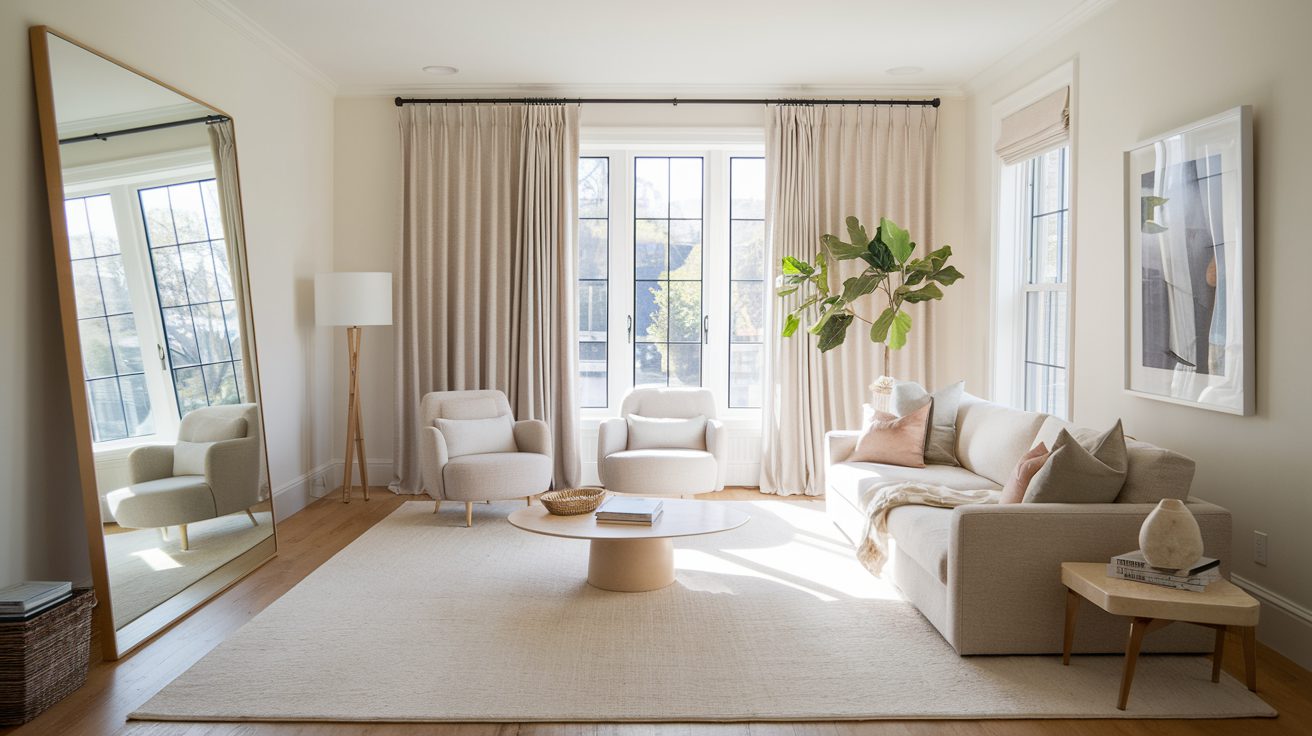
To make a room look bigger, start with light: pale walls, mirrors opposite windows, and floor-to-ceiling curtains. These three changes alone can make a 200 sq ft room feel 30–40% more spacious — no demolition required. I’ve tested these tricks across multiple apartments (including a 480 sq ft studio where every inch counted), and what follows are the 15 that actually move the needle.
The good news: most of these cost under $100. Some cost nothing at all.
Table of Contents
- Why Rooms Feel Small (It’s Not Always About Square Footage)
- 1. Choose the Right Paint Color
- 2. Use Mirrors Strategically
- 3. Hang Curtains High and Wide
- 4. Right-Size Your Furniture
- 5. Float Furniture Off the Walls
- 6. Ruthlessly Declutter Surfaces
- 7. Layer Your Lighting
- 8. Draw the Eye Upward with Vertical Lines
- 9. Use a Larger Rug Than You Think You Need
- 10. Choose Multi-Functional, Leggy Furniture
- 11. Go Monochromatic or Near-Monochromatic
- 12. Add Clear or Acrylic Pieces
- 13. Paint the Ceiling Slightly Lighter Than Walls
- 14. Maximize Natural Light
- 15. Use Open Shelving Instead of Closed Cabinets
- Which Tricks Work Best by Room
- FAQ
Why Rooms Feel Small (It’s Not Always About Square Footage)
A room feels small when visual boundaries are close together, surfaces are cluttered, and light is blocked or uneven. It’s a perception problem more than a size problem.
This is actually great news — because perception is something you can design. According to interior designer Nate Berkus, “The biggest design mistakes people make in small spaces come from trying to shrink everything down. You often need the opposite — bigger pieces, bolder choices — to make a small room feel expansive.”
The tricks below work by either reflecting light, creating visual depth, drawing the eye along longer sight lines, or eliminating the visual “noise” that makes spaces read as cramped.
1. Choose the Right Paint Color
Cost: $25–$60 for a gallon of quality paint
Light, cool-toned neutrals make walls appear to recede, which visually pushes the boundaries of the room outward. The best colors for this effect in 2026 are warm whites and soft off-whites — not pure white, which can feel clinical and actually highlight imperfections in walls.
My top picks for making rooms feel bigger:
- Benjamin Moore White Dove (OC-17) — soft, warm white that works in any light
- Sherwin-Williams Alabaster (SW 7008) — creamy, never harsh
- Benjamin Moore Pale Oak (OC-20) — greige that reads large in natural light
- Sherwin-Williams Accessible Beige (SW 7036) — warm neutral that doesn’t overwhelm
According to Sherwin-Williams design experts, painting your ceiling a shade lighter than your walls draws the eye upward and creates an illusion of height. For a more detailed breakdown of color choices by room type, see our guide to best paint colors for small rooms.
2. Use Mirrors Strategically
Cost: $20–$150 depending on size
A mirror positioned opposite a window doesn’t just reflect light — it creates the visual impression of a second window and doubles the apparent depth of the room. This is the single highest-impact trick for small spaces, and it costs less than a new throw pillow set.
After trying this in four different apartments, I’ve found the sweet spot is a mirror that’s at least 24 inches wide, hung at eye level, directly across from the room’s main light source. Full-length leaning mirrors (the kind from IKEA HOVET at $149 or Target’s Room Essentials version at $35) are even more effective because they reflect floor-to-ceiling.
Pro move: A gallery wall of 3–5 different-sized mirrors does double duty — it adds personality while multiplying the sense of space. Look for mismatched vintage frames at thrift stores and create your own. I’ve built a full mirror gallery wall for under $40 using Goodwill finds and some spray paint.
3. Hang Curtains High and Wide
Cost: $15–$80 per panel pair + $8–$20 for hardware
Hang curtain rods as close to the ceiling as possible — ideally 3–4 inches below the ceiling line — and extend the rod 6–12 inches beyond each side of the window frame. This creates the illusion that your windows are dramatically larger than they are, and draws the eye vertically, making ceilings feel higher.
Let curtains fall all the way to the floor. Curtains that stop mid-wall or hover above the floor look unintentional and actually make rooms feel shorter. Even if you’re renting and have to use a tension rod, the high-hang method still works.
For color: light linen or white curtains maximize light. Dark curtains in small rooms absorb light and close the space in. The only exception is if you’re going for a deliberately moody, cocoon aesthetic — in which case, own it fully with matching wall color.
4. Right-Size Your Furniture
Cost: varies — but the right-sized piece often costs the same as the wrong one
Oversized furniture overwhelms small rooms. But here’s what most people get wrong: too many small pieces also make rooms feel cramped. The goal is fewer, correctly scaled pieces — not miniaturizing everything.
A general rule: your sofa should not exceed 2/3 of the wall it sits against. A coffee table should be about 2/3 the length of your sofa. Leaving visual space around each piece is what makes the room breathe.
One sofa, one coffee table, one accent chair, one rug. That’s often enough for a complete, beautiful living room in a small space. The instinct to add more is usually the enemy of spaciousness.
5. Float Furniture Off the Walls
Cost: $0
Pull your sofa and major furniture pieces 6–18 inches away from the walls. This counterintuitive move creates breathing room around each piece and makes the floor plan feel intentional rather than crammed in.
The visual principle: when furniture hugs walls, the eye reads the perimeter of the room as the furniture boundary. When furniture floats, the eye reads the full floor as the room’s extent, making the space appear larger.
This pairs perfectly with the sofa room divider layout from our studio apartment layout guide — floating the sofa not only zones the space but visually expands it simultaneously.
6. Ruthlessly Declutter Surfaces
Cost: $0 (and you might make money selling what you remove)
Visual clutter is the fastest way to make any room feel smaller. Every object on a surface — every stack of mail, every decorative piece, every coffee mug — takes up visual real estate. The brain reads clutter as chaos, and chaos reads as cramped.
The rule I live by: surfaces should be 70% clear. The remaining 30% is intentional styling — a plant, a lamp, a single decorative object that you genuinely love. That’s it. If you want organization tips to make decluttering stick, our room-by-room spring cleaning checklist is a great starting point.
7. Layer Your Lighting
Cost: $30–$150 for floor and table lamps
A single overhead fixture creates flat, uniform light that flattens a room. Layered lighting — overhead ambient, floor lamps for zones, table lamps for warmth, potentially under-cabinet or shelf lighting — creates depth and makes a room feel both larger and more sophisticated.
Homes and Gardens notes that layered lighting is one of the biggest design trends for 2025–2026 specifically because of its spaciousness effect in smaller rooms. A floor lamp in a corner makes that corner recede visually. A table lamp at sofa level creates a warm glow that makes the ceiling feel higher by contrast.
Budget win: You don’t need expensive fixtures. A $25 IKEA floor lamp, a $15 table lamp, and some smart bulbs that let you warm the color temperature in the evening will do more for your space than a $300 pendant.
8. Draw the Eye Upward with Vertical Lines
Cost: $0–$50
Tall vertical elements — a floor-to-ceiling bookshelf, a tall plant, a vertically striped accent wall, a gallery wall arranged in a tall column — draw the eye upward and make ceilings feel higher. This is one of the fastest ways to make a low-ceiling room feel more open.
An IKEA BILLY bookcase (about $80) installed with the top near the ceiling, styled with plants trailing from the upper shelves, is one of the most dramatic small-space transformations I know of. The cost-to-impact ratio is almost unbeatable.
9. Use a Larger Rug Than You Think You Need
Cost: $50–$200 for a quality 8×10 from Ruggable, Amazon, or HomeGoods
The most common rug mistake in small rooms is going too small. A rug that only fits under the coffee table (and not under the front legs of the sofa) looks like a postage stamp and actually makes the room feel smaller by creating a tiny island of color.
In a living room, go for at minimum an 8×10 rug. The front legs of all seating should rest on it. In a bedroom, a rug should extend at least 18–24 inches on each side of the bed so your feet hit rug when you get up.
A cheap small rug that you’ll replace in a year costs the same as a quality larger one from HomeGoods. Learned that the hard way — twice.
10. Choose Multi-Functional, Leggy Furniture
Cost: same as standard furniture — just choose differently
Furniture with visible legs creates the perception of more floor space because your eye can see under the piece, which makes the room feel continuous and uninterrupted. A sofa on legs looks lighter and less imposing than a sofa with a solid base. Same for coffee tables, accent chairs, and nightstands.
Multi-functional pieces reduce the total number of items in a room. A storage ottoman replaces both a coffee table and a storage unit. A lift-top coffee table replaces a coffee table and a side table. A bed with drawers underneath replaces a dresser. Fewer pieces = less visual clutter = bigger feeling room.
11. Go Monochromatic or Near-Monochromatic
Cost: $0 if you shop what you already own; $20–$100 for accessories
When walls, floors, and furniture are in the same color family, the eye doesn’t stop at each surface — it flows continuously through the space, making it feel seamless and larger. This is a trick designer Kelly Wearstler uses even in her large projects: “A room reads as more expansive when the color story is unified.”
You don’t need to paint everything the same color. Just keep the undertones consistent. Warm greige walls, natural wood floors, cream sofa, tan throw — these all exist in the same warm neutral family, and the room will feel cohesive and open. Introduce your personality through texture (velvet cushions, a woven basket, a linen curtain) rather than contrasting colors.
12. Add Clear or Acrylic Pieces
Cost: $30–$120
Acrylic and glass furniture pieces are visually lightweight — the eye passes through them rather than stopping on them. A clear acrylic side table takes up the same physical space as a solid wood one but reads as almost invisible in a room, preserving the sense of open floor.
Good options: clear acrylic side tables ($30–$60 on Amazon), glass coffee tables, lucite chairs. Use sparingly — one or two clear pieces strategically placed, not a whole room of them.
13. Paint the Ceiling Slightly Lighter Than Your Walls
Cost: one quart of paint, about $15–$20
Most people paint their ceilings bright white regardless of wall color. Instead, try mixing your wall paint color with 50% white and using that for the ceiling. The subtle gradient from wall to ceiling makes the ceiling appear to float higher and creates a more sophisticated, boutique-hotel feel.
Alternatively, if you already have white walls, simply use the same white on the ceiling. The continuity makes walls and ceiling feel like one unbroken surface, eliminating the hard visual “stop” at the ceiling line that makes rooms feel boxed in.
14. Maximize Natural Light
Cost: $0–$40
Natural light makes spaces feel expansive. The goal is to get as much of it into the room as possible and then reflect it around. Start by removing anything that blocks windows: heavy curtains, furniture placed in front of windows, window films.
Clean your windows — it sounds obvious, but dirty windows block meaningful light. A clean window can let in noticeably more light than a film-coated one. I cleaned the windows in my studio and was genuinely surprised by the difference.
If your windows face north or are obstructed, compensate with warm artificial lighting and extra mirrors. Light-colored surfaces bounce artificial light effectively too — a white ceiling bounces far more light than a dark one.
15. Use Open Shelving Instead of Closed Cabinets
Cost: $20–$100 for floating shelves
Closed cabinets create solid visual blocks. Open shelves let the eye continue past the shelf to the wall behind, creating depth. In a kitchen or living room, replacing one run of upper cabinets with open floating shelves immediately opens up the space.
The caveat: open shelves show everything, so they need to be styled intentionally. Keep only items you use regularly on open shelves; store everything else behind closed doors. For kitchen styling inspiration, the Dollar Store kitchen organization review has honest recommendations for what to display vs. hide.
Which Tricks Work Best by Room
| Room | Top 3 Tricks |
|---|---|
| Living Room | Large rug (#9), Float furniture (#5), Mirror opposite window (#2) |
| Bedroom | Floor-to-ceiling curtains (#3), Leggy furniture (#10), Light paint (#1) |
| Kitchen | Open shelving (#15), Maximize light (#14), Declutter surfaces (#6) |
| Bathroom | Mirror wall (#2), Vertical lines (#8), Monochromatic palette (#11) |
| Studio Apartment | All 15 — start with paint, mirrors, and curtains |
For a comprehensive look at studio apartment strategies, pair these tricks with our detailed studio apartment layout guide. And if you’re working with a small space on a budget, the complete 2026 budget home decorating guide prioritizes which investments give you the most impact for the least money.
For renter-specific ideas, explore renter-friendly upgrades that apply many of these visual expansion techniques without requiring permanent changes.
Frequently Asked Questions
What paint color makes a room look the biggest?
Warm whites and soft off-whites make rooms look the biggest. Specifically, Benjamin Moore White Dove (OC-17), Sherwin-Williams Alabaster (SW 7008), and Benjamin Moore Pale Oak (OC-20) consistently expand spaces visually. Avoid bright, cool whites — they can feel clinical and actually highlight the room’s boundaries. Light reflects off warm whites more naturally, which is what creates the spacious effect.
Does dark paint make a room look smaller?
Not necessarily — used strategically, dark paint can make a room feel more expansive by making walls recede into shadow. But in rooms with limited natural light, dark paint will absorb light and create a cavelike effect. Dark paint works best in rooms with ample natural light, or when used intentionally as an accent wall to create depth.
Where is the best place to hang a mirror to make a room look bigger?
Hang a mirror directly opposite your room’s main window. This creates the illusion of a second window and bounces natural light around the room, making it feel significantly larger. The mirror should be at least 24 inches wide — larger is better. A full-length leaning mirror in a corner is also highly effective, as it reflects floor-to-ceiling and adds visual depth in two dimensions.
Should curtains be the same color as the walls to make a room look bigger?
Yes — matching or closely coordinating curtains to your wall color creates a seamless, uninterrupted surface that makes walls look wider and ceilings taller. This is especially effective with curtains hung close to the ceiling and falling to the floor. Contrasting curtains create visual stops that break up the space and make it feel more segmented and smaller.
Do area rugs make rooms look bigger or smaller?
A correctly sized rug makes rooms look significantly bigger; a too-small rug makes them look smaller. In a living room, use at minimum an 8×10 rug with front furniture legs resting on it. A rug that only fits under the coffee table creates a visual island that shrinks the apparent floor area. Light-colored, low-pile rugs make the most expansive impression.
What furniture should you avoid in a small room?
Avoid: oversized sofas that span more than 2/3 of a wall; beds larger than a full/queen unless your room is 12+ feet wide; solid-base furniture that blocks sightlines to the floor; too many small pieces (they create visual clutter that reads as cramped); and dark, heavy accent pieces that absorb light. Also avoid blocking windows with furniture — even a few inches of obstruction meaningfully reduces the natural light that makes a room feel spacious.
You don’t need to do all 15 of these at once. Start with the free and cheap tricks — declutter surfaces, float your furniture, clean your windows. Then work up to paint, curtains, and a proper rug. Each change compounds on the ones before it. Most people are genuinely surprised at how dramatically different a room feels after even three or four of these changes. Give it a weekend.
Leave a Reply