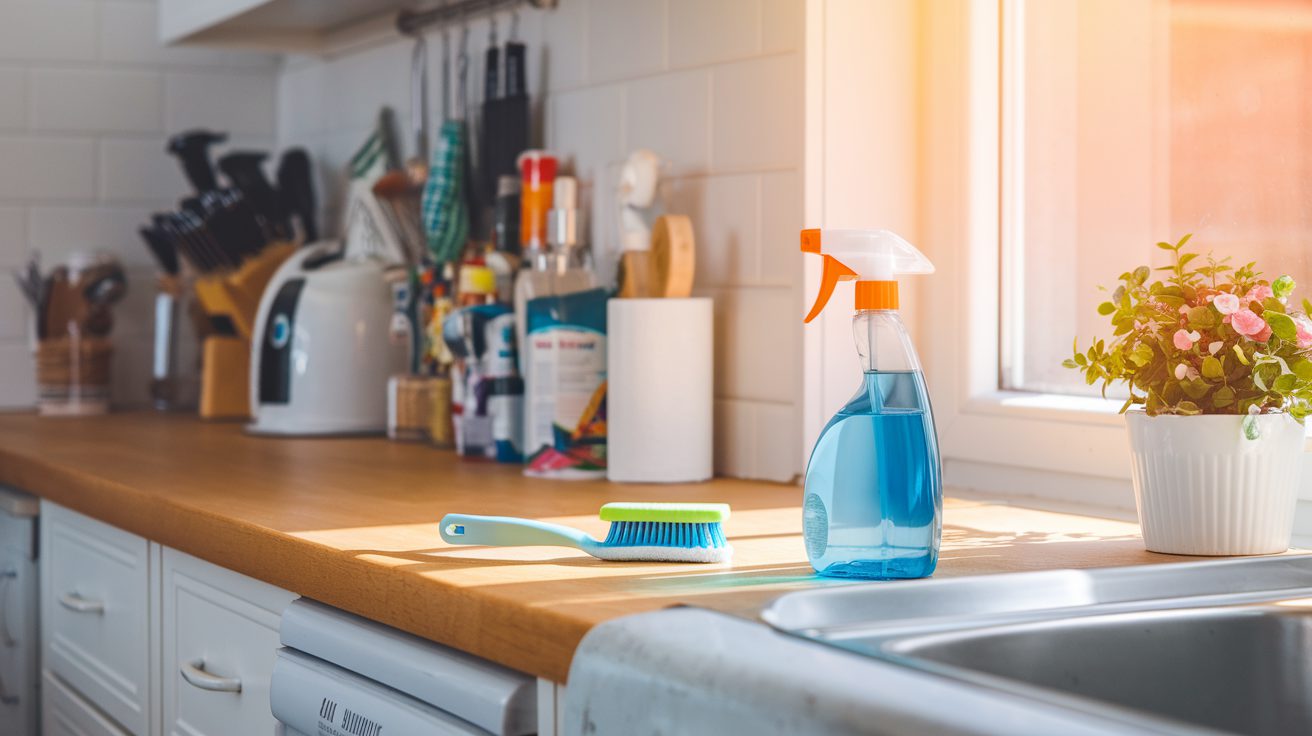
A 30-minute kitchen deep clean works in six 5-minute blocks: minutes 1–5 clear all counters, 5–10 wipe appliance exteriors and handles, 10–15 purge expired fridge items, 15–20 organize one cabinet, 20–25 scrub sink and fixtures, 25–30 sweep and spot-mop the floor. The five spots most people forget: dishwasher filter, trash can interior, range hood filter, light switch plates, and the under-sink area.
I’ll be honest: I set a timer for 30 minutes and told myself I’d prove the method works. I did not finish in 30 minutes. The fridge alone took 12 minutes because I had a mystery container situation — something in a Ziploc bag from an unknowable date, suspicious green tinge, no label. That kind of chaos adds up. But here’s what I learned: with the right sequence and the right products ready to grab, 30 minutes gets the kitchen genuinely clean — not “closed my eyes and pretended” clean, actually clean — if you stick to the blocks strictly.
This guide is the kitchen-specific deep dive that pairs with our ultimate spring cleaning checklist. If you’ve already done the whole-house version and just need the kitchen knocked out fast, this is your go-to. Products I used are all budget-friendly — most under $5 and several from Dollar Tree or Walmart.
The 30-Minute Kitchen Deep Clean: Block-by-Block Breakdown
Set your timer. Work through each block completely before moving to the next. Don’t reorganize your spice rack during block 3. Don’t start scrubbing the stovetop in block 1. Sequence matters — this order prevents rework.
⏱ Minutes 0–5: Counter Clear + Spray Everything
Every single thing on your counters goes somewhere — into a cabinet, into the trash, or onto the kitchen table temporarily. Don’t sort, don’t organize, just relocate. Once the counters are bare, spray them, the stovetop, the outside of the microwave, and all appliance handles with Method All-Purpose Cleaner ($3.99 at Target) or Mrs. Meyer’s Multi-Surface Spray ($4.49). Let it sit and dwell while you move to block 2.
This is where most people go wrong: they start wiping immediately. Don’t. The dwell time does the heavy lifting. Spray first, wipe later.
⏱ Minutes 5–10: Appliance Exteriors + Handles
Go back and wipe everything you sprayed. Microwave exterior, fridge handle, dishwasher front, oven handle. Use a microfiber cloth — not paper towels, they streak on stainless steel. For fingerprints on a stainless steel fridge, Weiman Stainless Steel Wipes ($5 at Walmart) are worth it — I tried the olive oil trick from TikTok first (see our 6 Viral TikTok Cleaning Hacks: Only 2 Actually Worked post) and it left a greasy haze. The dedicated stainless wipes won that round.
While you’re here: pop a Angry Mama Microwave Cleaner (about $4 at Dollar Tree or Amazon) in the microwave with water and a splash of white vinegar. Run it for 7 minutes. You’ll deal with the inside in block 3. The steam does the cleaning while you’re doing other things.
⏱ Minutes 10–15: Fridge Purge (The Hardest 5 Minutes)
This block will make or break your 30 minutes. You are NOT organizing your fridge right now. You are only removing: anything expired, anything that’s grown a personality, and anything that’s been in there so long you’ve forgotten what it was. Toss. Don’t smell it. Don’t debate it. If you’re asking “is this still good?” the answer is no.
After pulling expired items, wipe one shelf with a damp cloth. Just one. The rest gets done during your full monthly clean. Perfectionists will hate this. It works.
Also: wipe the microwave interior now. The Angry Mama steam has had 5 minutes to work. The grime comes off with almost zero effort — just a damp cloth and it wipes clean. I’ve tried Clorox wipes on a cold microwave and scrubbed for two minutes; the Angry Mama method took 20 seconds. Not exaggerating.
⏱ Minutes 15–20: One Cabinet Audit
Pick the cabinet that’s been quietly embarrassing you. For me it’s always the one with 14 mismatched Tupperware lids and no matching bottoms. Pull everything out, wipe the interior with a Magic Eraser (Dollar Tree, $1.25), put back only what’s useful, and stack properly.
This is also when you do your pantry audit mini-check if your pantry is accessible from the kitchen. Pull the front row of items and check dates. See the section below for which expired items are actually still safe vs. which ones to toss.
For better long-term cabinet organization on a budget, check out our Dollar Store Kitchen Organization: What’s Worth It guide — we tested which Dollar Tree bins and organizers actually held up.
⏱ Minutes 20–25: Sink + Fixtures
The kitchen sink is one of the most bacteria-dense surfaces in a home — microbiology studies have found higher bacterial loads in kitchen sink drains than on toilet seats. Users from r/CleaningTips have noted this too; u/FuzzyManPeach (7 upvotes) shared after growing cultures in an online microbiology class: “The drain in the kitchen sink grew the grossest stuff out of all of them.”
Sprinkle Bar Keepers Friend ($2.49 at Target) on stainless steel sinks and scrub with a Scrub Daddy ($2.49 at most grocery stores). Rinse the drain with boiling water or a pour of baking soda followed by white vinegar. For chrome faucets, The Pink Stuff paste (~$5 at Walmart) on a soft cloth removes hard water stains without scratching. Don’t use it on brushed nickel — learned that one the hard way.
Also wipe the light switch plates right now. u/Lizzie_001 (7 upvotes, r/CleaningTips) nailed it: “Touchy-feely things. Light switches/plates, doorknobs/area surrounding them… anything that gets touched on a regular basis.” A Clorox wipe takes 10 seconds and it’s done.
⏱ Minutes 25–30: Floor Sweep + Spot Mop
Sweep first — always. Mopping over crumbs just smears them. I use a Swiffer Sweeper for the dry pass (the disposable pads catch pet hair better than a broom for me), then a quick pass with an O-Cedar EasyWring Spin Mop for sticky spots. If you don’t have time for a full mop, a spray of Method Squirt + Mop floor cleaner directly on problem spots and wipe with a paper towel takes 90 seconds.
Total time on my actual run-through: 38 minutes. The mystery container cost me 3 extra minutes, and I spent 5 minutes looking for where I’d put the Bar Keepers Friend. If everything’s staged and ready, 30 minutes is genuinely achievable.
The 5 Things You’re Forgetting to Clean (r/CleaningTips Research)
These came directly from r/CleaningTips threads on overlooked cleaning spots. Not generic advice — these are the specific items the community consistently flags as the most neglected surfaces in a kitchen.
- Dishwasher filter: Most people have never cleaned it. Ever. It’s usually a twist-off cylinder at the bottom of the dishwasher tub, under the lower spray arm. For Bosch and Samsung dishwashers, it’s a two-part filter — unscrew counterclockwise, rinse under hot water, use a soft brush. u/Global_Research_9335 (r/CleaningTips) says: “I give mine a squirt of Dawn Powerwash then pop them in the dishwasher and they come as good as new.” For deeper buildup, an Affresh dishwasher tablet ($8 for 6 at Target) monthly keeps it from getting that point. Uncleaned filters cause the “my dishwasher smells bad” problem that dozens of Reddit posts are about.
- Range hood filter: Grease traps everything. u/azooey73 (r/CleaningTips): “The filters above the stove, part of the exhaust system, go in the dishwasher if I remember.” Some aluminum mesh filters are dishwasher-safe — check your model. For baked-on grease, soak in hot water with Dawn Powerwash for 20 minutes before scrubbing. u/Zelda_Momma called it out directly: “Stove hood filter” as one of the most forgotten kitchen items.
- Trash can interior: The liner catches most of it, but leaks happen. Spray the inside with Clorox wipes or a disinfectant spray every other week. Takes 45 seconds.
- Light switch plates: u/FabulousDentist3079 (r/CleaningTips): “TV remote, door knobs, light switch plates” — these are the highest-touch surfaces that almost nobody wipes during a kitchen clean. In flu season, this matters.
- Under-sink cabinet: The space under the sink tends to collect leaky bottle drips, rust rings from cleaning supplies, and mystery puddles. Wipe it out, check the pipes while you’re in there, and consider a Dollar Tree plastic tray to organize cleaning supplies and catch drips.
Pantry Audit: Which Expired Items Are Actually Fine (And Which Aren’t)
The generic advice is “throw away anything past its date.” The reality, according to actual food science and the r/ZeroWaste community, is more nuanced. u/coronarybee (44 upvotes, r/ZeroWaste) explained it plainly: “As a packaging engineer, the only reason things like that have expiration dates is because they’re required. The expiration date is usually some arbitrary length of time that the company decided to test to.”
u/NotNearlyNormal (18 upvotes, r/ZeroWaste) put it this way: “That’s not really an expiration date. Meats, dairy, and baby formula all have true expiration dates. The rest are just freshness dates. If it’s not compromised, it should be fine to eat.”
The FDA’s food product dating guidelines confirm this: “best if used by” dates are quality indicators, not safety indicators (with the exception of infant formula). Here’s a practical breakdown:
- Still good past date: Dry pasta, white rice, canned goods (if no damage/swelling), dried beans, honey (indefinitely), white vinegar, salt, sugar, whole spices (lose potency but not safety), plain oats, baking soda
- Toss past date: Cooking oils (go rancid — u/KokoTheTalkingApe explained this about oats’ fat content and it applies to oils doubly), whole grain flours (oils in the bran oxidize), open nut butters after 3 months, anything that smells off, swollen cans
- Gray zone — use your senses: Ground spices (still “safe,” but a 4-year-old chili powder has no flavor), opened condiments, jarred sauces
During block 4’s cabinet audit, pull duplicate purchases to the front. r/Cooking threads show this is the #1 pantry waste driver — buying a second jar of cumin before realizing you already had one. Group duplicates together and use them first.
For more on spring organizing on a tight budget, our Dollar Tree Spring Refresh post shows what $15 can do across your whole home — including the kitchen.
What to Actually Stock After Your Clean
Once you’ve purged, the restock list is short. These are the items I actually keep under my sink for kitchen cleaning:
- Dawn Powerwash — for range hood filters, baked-on grime, and general degreasing
- Bar Keepers Friend — sink, stovetop, any stainless surface
- Method All-Purpose or Mrs. Meyer’s — counter spray
- The Pink Stuff paste — hard water, chrome faucets
- Scrub Daddy + Scrub Mommy — one coarse (Daddy) for stovetop rings, one soft (Mommy) for non-stick
- Affresh dishwasher tablets — monthly dishwasher maintenance
- Magic Eraser — from Dollar Tree, fine for cabinets and walls
- Clorox wipes — handles, light switches, trash can spot-wipes
Most of this list is under $5 per item. The Scrub Daddy costs more than Dollar Tree scrubbers but it’s the one cleaning tool I’ve replaced the least — it lasts 2+ months with regular use where dollar store sponges disintegrate in a week. That’s not a paid endorsement; it’s just the math.
For cleaning product safety — especially if you have kids or pets — the EPA’s Safer Choice program certifies products that are safer for people and the environment. Method and Mrs. Meyer’s both have Safer Choice certified products in their lines.
Also: if you love a good hack, go check our round-up of 6 Viral TikTok Cleaning Hacks: Only 2 Actually Worked — we tested the lemon + microwave trick, the toilet cleaning tablet hack, and several others so you don’t have to.
Frequently Asked Questions
How do you deep clean a kitchen in 30 minutes?
Break the kitchen into six 5-minute blocks: (1) clear counters and spray all surfaces, (2) wipe appliance exteriors and handles, (3) purge fridge of expired items and wipe microwave, (4) audit one cabinet, (5) scrub sink and wipe switch plates, (6) sweep and spot-mop the floor. Prep your products in advance so you’re not hunting for supplies mid-clean.
What should I throw away when spring cleaning the kitchen?
Toss: rancid cooking oils, whole grain flours past 6 months, anything with mold, cracked containers, duplicate items you’ll never use, expired medications from the junk drawer, and any fridge mystery containers you can’t identify. For pantry dry goods, use your senses — “best by” dates on canned goods and dry pasta are quality indicators, not safety cutoffs, per FDA guidelines.
How often should you deep clean your kitchen?
A full deep clean — including appliance interiors, cabinet wipe-down, and behind/under appliances — should happen 2–4 times per year, with spring being the most impactful timing. Weekly maintenance (wipe counters, scrub sink, sweep floor) keeps the deep clean manageable. Monthly tasks: clean the dishwasher filter, check fridge for forgotten items, wipe range hood filters.
What are the best kitchen cleaning products on a budget?
Best budget kitchen cleaners: Bar Keepers Friend ($2.49) for sinks and stainless, Dawn Powerwash ($3.99) for degreasing anything, Method All-Purpose spray ($3.99) for counters, Magic Eraser from Dollar Tree ($1.25) for scuffs and cabinet marks, and Affresh dishwasher tablets ($8 for 6) for monthly dishwasher maintenance. Scrub Daddy ($2.49) costs more than dollar store sponges but lasts significantly longer.
Leave a Reply